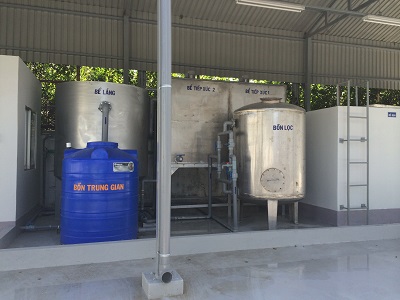
TEXTILE DYEING WASTEWATER TREATMENT SYSTEM
1. Introduction
- Weaving and dyeing in our country is an industry with a large production network with many items, many types and recently very high economic growth. However, weaving and dyeing technology uses a sizable amount of water for production stages and discharges an average amount of wastewater from 12 to 300 m3 / ton of fabric. In which, the main source of pollution is wastewater from textile dyeing and cooking. Laundry wastewater has pH: 9 - 12, high organic matter content (can be up to 500 mg / l), color temperature can be below 800 Pt - Co, SS content can be 1500 mg / l. The concentrations of pollutants are summarized in figure 1.
- The current conventional textile and dyeing wastewater treatment techniques do not completely remove the large degree and amount of COD
- If the color of textile wastewater is not treated, after being discharged into the receiving environment, it will lose the landscape and environment, but also affect the ability to diffuse light into the water, affecting the aquatic system. In addition, the dyeing wastewater also contains a very high content of heavy metals, which is also a cause of poisoning to humans and the host biota.
2. Advantages
- Combining both physical and chemical methods.
- High processing efficiency.
- Less wasted area suitable for the waste capacity of the plant.
- Technology process is simple, easy to operate.
- Low cost
3. Disadvantage
- The effluent only meets B standard, the system is affected by temperature
Please contact us through our hotline or send us an e-mail for more information. We are very pleased to serve you!