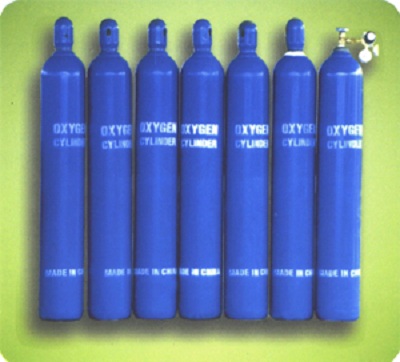
OXYGEN
Characteristics:
Oxygen is the most abundant element in the Earths crust. It is estimated to make up 46.7% of the Earths crust by mass. Oxygen accounts for about 87% of the mass of the oceans (in the form of H₂O, or water) and 20% of the Earths atmosphere by volume (as molecular oxygen O₂ or ozone O₃). Oxygen compounds, primarily silicates (SiO₄⁴⁻) and carbonates (CO₃²⁻), are found in soil and rock. Frozen water is a common solid on other planets as well as comets. The polar ice caps on Mars are composed of frozen carbon dioxide.
Oxygen compounds are found throughout the universe, and oxygen’s spectral lines have been detected in stars.
Under standard temperature and pressure, oxygen is a gas in molecular form (a diatomic molecule), with the chemical formula O₂. Oxygen is a vital component of air, produced by plants during photosynthesis, and is essential for the respiration of humans and animals.
Liquid and solid oxygen are pale blue in color, and both are paramagnetic substances. Liquid oxygen is commonly obtained by the fractional distillation of liquefied air. Both liquid and solid ozone (O₃) have a deep blue color.
Gaseous Oxygen
- Filling Pressure: 150 kg/cm²
- Cylinder Capacity: 6 – 6.5 m³
Liquid Oxygen
- Container: XL – 45.165 liters
Applications:
Oxygen is used as an oxidizing agent, with only fluorine having a higher electronegativity. Liquid oxygen is used as an oxidizer in rocket propulsion systems. As it supports respiration, oxygen is widely used in the medical field. Supplemental oxygen is also provided to mountain climbers and airline passengers when needed. Oxygen is used in welding technology, as well as in the production of steel and methanol.
Oxygen, as a mild stimulant, has a history of recreational use, which continues today. Oxygen bars can be seen at festivals and events. In the 19th century, oxygen was often mixed with nitrous oxide for use as an anesthetic.
For further information, please contact Hai Tin Company