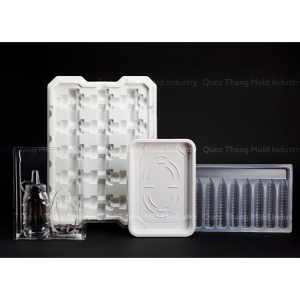
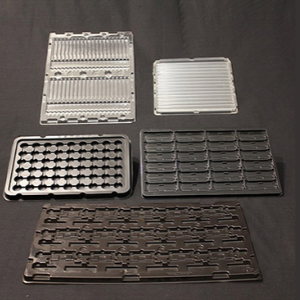
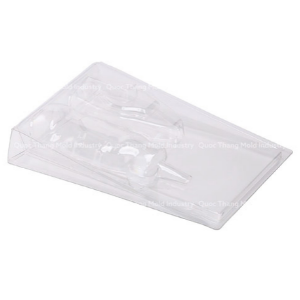
ESD PLASTIC TRAYS – ELECTROSTATIC CONTROL FOR ELECTRONIC COMPONENTS
ESD plastic trays are designed to hold, secure, store and transport electronic components in environments where electrostatic discharge (ESD) control is required. Their molded cavities help keep components in designated positions and reduce unwanted movement during handling. These trays support packaging and handling requirements for integrated circuits (ICs), semiconductor chips, printed circuit boards (PCBs), sensors and other sensitive electronic parts.
1. How Do ESD Plastic Trays Support Electronics Manufacturing?
Electrostatic discharge (ESD) occurs when accumulated electrical charge is released between surfaces at different electrical potentials. Charge can develop through friction, contact and movement during component handling, storage or transportation. Sensitive electronic components may be affected by electrostatic discharge, even when the discharge is not perceptible to the operator.
ESD plastic trays address three key handling requirements:
- Electrostatic control: Depending on the material and surface resistivity, the tray helps limit charge accumulation or dissipate electrical charge.
- Component positioning: Molded cavities hold components in designated positions, helping reduce unwanted movement and physical contact.
- Automation support: Appropriately designed cavities facilitate component picking and placement in automated assembly lines.
These trays can be used for packaging, warehouse storage, transfers between production stages and transportation of electronic components.
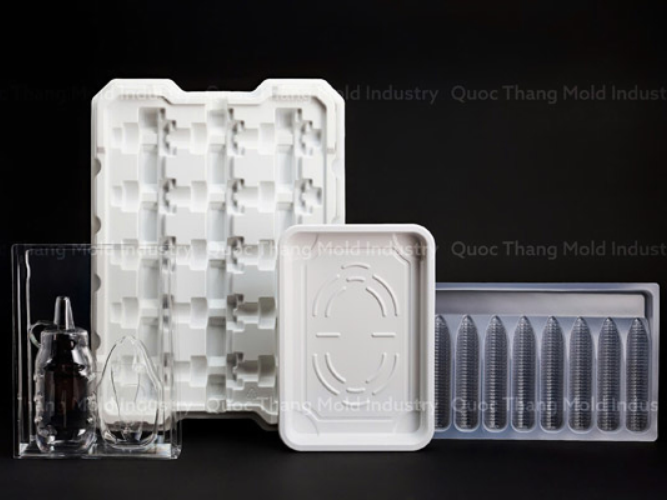
ESD plastic tray for holding and organizing electronic components
2. Surface Resistivity by ESD Classification
The appropriate ESD tray depends on the electrostatic control requirements of the electronic components being handled. Three categories can be distinguished by their surface resistivity ranges.
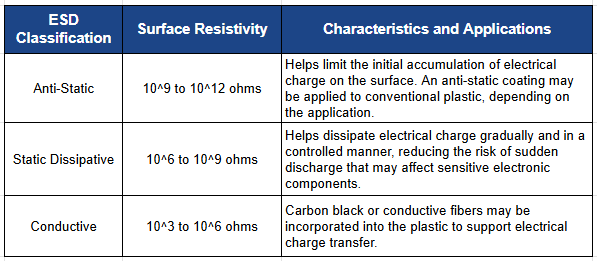
The appropriate resistivity range depends on component sensitivity and the requirements of the handling environment. Surface resistivity should be confirmed for the specific tray material and design.
3. Choosing Plastic Materials for Different Operating Conditions
ESD plastic trays can use different materials depending on the required rigidity, toughness, chemical resistance and operating temperature.
- ESD Polystyrene (PS): PS offers high rigidity, a smooth surface and good shape retention. Black PS incorporating carbon is used in applications involving chip trays, small circuit boards and automated component handling, where maintaining component position is important.
- ESD Polyethylene Terephthalate (PET): PET offers flexibility and toughness, helping reduce the risk of cracking or breakage during handling and transportation. It is suitable for applications where resistance to physical impact and handling stress is an important consideration.
- ESD Polypropylene (PP): PP offers chemical resistance and can provide greater heat resistance in suitable applications. Depending on the material grade and operating conditions, ESD PP trays may be suitable for component drying or other production processes involving elevated temperatures.
Material ion should account for component characteristics, handling procedures and the operating environment.
4. How Does Tray Design Affect Handling and Transportation?
Tray geometry influences component retention, handling convenience and compatibility with production equipment.
- Custom cavities: Cavities can be designed around component dimensions to help secure parts and reduce unwanted movement or physical impact.
- Automated pick-and-place compatibility: Appropriately dimensioned cavities help equipment locate and retrieve components, reducing the risk of misalignment or jamming.
- Stacking and nesting: Suitable tray designs allow loaded trays to be stacked or empty trays to nest together, helping optimize storage and transportation space.
The effectiveness of these features depends on the actual tray configuration, dimensional tolerances, component geometry and handling equipment.
5. Quoc Thang ESD Plastic Trays for Electronic Component Packaging
Quoc Thang Model Industry Company Limited offers ESD plastic trays for electronic component packaging and handling applications. These trays support component organization, positioning and protection during storage, assembly and transportation.
PS, PET and PP are material options to consider when evaluating rigidity, flexibility, chemical resistance and temperature requirements. The appropriate material, surface resistivity and cavity configuration depend on the components being handled and the conditions of use.
Quoc Thang Model Industry Company Limited provides ESD plastic tray solutions for electronic component packaging and handling. Buyers can discuss component dimensions, material requirements, electrostatic control needs and preferred tray configurations to identify a suitable solution for their production workflow.
Contact Quoc Thang to discuss your electronic component packaging requirements and explore suitable ESD tray options.