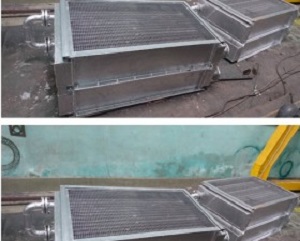
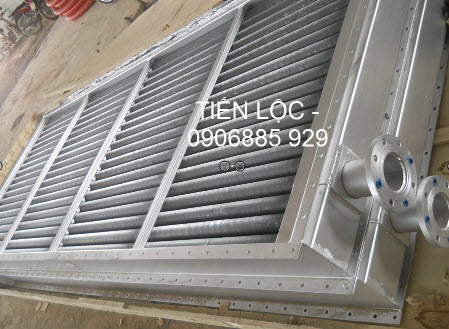
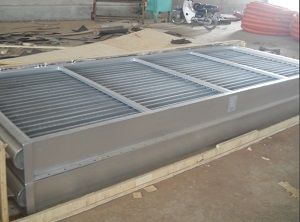
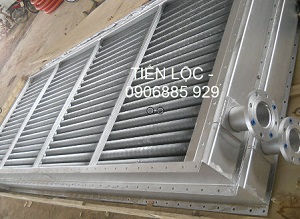
THERMAL OIL HEAT EXCHANGER
Tien Loc Trading And Production Industry Equipment Company Limited specializes in manufacturing, designing, and installing: heat exchangers, including calorifier heat exchangers, steam heat exchangers, thermal oil heat exchangers, helical coil heat exchangers, shell-and-tube heat exchangers, spiral fin heat exchangers, heat-dissipating fins, etc.
Tien Loc continuously invests in equipment and workforce to provide customers with quality products at reasonable prices.
❖ U-Tube Heat Exchanger
Advantages
- The tube bundle can freely expand and contract.
- Good thermal expansion compensation performance.
- Strong pressure resistance.
- Convenient for maintenance and cleaning.
- Simple structure and low cost.
Disadvantages
- Cleaning the inside of the tubes is very inconvenient.
- Only suitable for certain applications.
❖ Immersed Coil Heat Exchanger
Performance Characteristics
The structure of this type of tubular heat exchanger is relatively simple, compact, and inexpensive, but the outside of the tubes cannot be mechanically cleaned. The tube bundle of this type of heat exchanger is connected to tube sheets, and the corresponding tube sheets are welded to both ends of the shell, while an upper cover is connected to the tube sheets. The upper cover and shell are equipped with inlet and outlet pipelines for the fluid.
A series of baffles perpendicular to the tube bundle are usually installed outside the tubes. At the same time, the connections between the tubes and tube sheets and between the tube sheets and shell are rigid, while fluids with different temperatures flow inside and outside the tubes.
Therefore, when there is a large temperature difference between the tube wall and shell wall, due to the difference in thermal expansion between the two sides, significant thermal stress is generated, causing the tubes to twist or become loose from the tube sheets, or even resulting in damage to the heat exchanger.
❖ Spiral Plate Heat Exchanger
Performance Characteristics
- High heat transfer efficiency (good performance).
- Effective recovery of low-temperature thermal energy.
- Strong operational reliability.
- Low resistance.
❖ Spray Heat Exchanger
Performance Characteristics
This type of heat exchanger fixes the heat exchange tubes in rows on a steel frame. The hot fluid flows through the tubes, while cooling water from the spray device above is evenly sprayed downward, so it is also called a spray cooling heat exchanger. Outside the heat exchange tubes of the spray type is a liquid film with higher turbulence, and the external heat transfer coefficient of the tubes is much higher than that of the immersed type.
In addition, most of these heat exchangers are installed in circulating air. The evaporation of the cooling water also removes part of the heat, which can reduce the temperature of the cooling water and increase the driving force for heat transfer. Therefore, compared with the immersed type, the heat transfer efficiency of spray heat exchangers is greatly improved.
❖ Heat Pipe Heat Exchanger
Performance Characteristics
A heat pipe heat exchanger can completely separate the hot and cold fluids through the internal partition wall of the heat exchanger. During operation, when a single heat pipe fails due to wear, corrosion, overheating, or other reasons, it basically does not affect the operation of the heat exchanger.
The hot and cold fluids in a heat pipe heat exchanger flow completely separately, making it easy to achieve counter-current heat exchange between the hot and cold fluids.
For fluids with high dust content, heat pipe heat exchangers can solve problems related to heat exchanger wear and ash blockage by changing the structure and expanding the heating surface.
When a heat pipe heat exchanger is used to recover heat from corrosive exhaust gases, the temperature of the heat pipe wall can be adjusted by adjusting the heat transfer area of the evaporating and condensing sections, thereby allowing the heat pipe to avoid the most severely corrosive areas as much as possible.
❖ Double-Pipe Heat Exchanger
Advantages
- Can be increased or decreased as required because it is composed of standard components.
- Simple structure and a wide operating range.
- Both sides of the heat transfer surface have higher heat transfer capacity.
- Convenient for installation.
Disadvantages
- Maintenance, cleaning, and disassembly are complicated and may easily cause leakage.
- Material ion is limited.
- There is no unified welding standard for double-pipe heat exchangers.
❖ Jacketed Heat Exchanger
Performance Characteristics
Simple structure, but the heating surface is limited by the vessel wall, resulting in a relatively low heat transfer coefficient. To improve the heat transfer coefficient and ensure uniform heating of the fluid in the vessel, an agitator can be installed inside the vessel.
When cooling water or a heating medium without phase change is introduced into the jacket, spiral baffles or other measures to increase turbulence can also be arranged inside the jacket to increase the heat transfer coefficient on one side of the jacket. To compensate for the insufficient heat transfer surface, a solid coil can also be installed inside the vessel. Jacketed heat exchangers are widely used for heating and cooling during reaction processes.
❖ Plate Heat Exchanger
Performance Characteristics
High heat transfer efficiency.
Compact, because plate heat exchangers have extended secondary surfaces, and their specific surface area can reach 1,000 m²/m³.
Lightweight, because they are compact and mainly made of aluminum alloys. Steel, copper, composite, and other materials are also now mass-produced.
Highly adaptable, and plate heat exchangers can be applied to: gas-to-gas, gas-to-liquid, liquid-to-liquid heat exchange, heat exchange between different fluids, and phase-change heat transfer involving concentration changes.
The manufacturing process has strict requirements and is complex.
Prone to clogging, not corrosion-resistant, and difficult to clean and repair, so they can only be used where the heat exchange media are clean, non-corrosive, not prone to scaling, and not easily blocked.
❖ Hot Film Heat Exchanger
Performance Characteristics
High efficiency and energy saving, with a heat transfer coefficient of 6,000–8,000 W/(m²·°C).
Fast heat transfer rate, high-temperature resistance (400°C), and high-pressure resistance (2.5 MPa).
Compact structure, small footprint, lightweight, convenient installation, and reduced civil construction investment costs.
Flexible design, complete specifications, strong practical applicability, and cost savings.
Wide range of application conditions, suitable for high pressure, a wide temperature range, and heat exchange involving various media.
Low maintenance costs, easy operation, long cleaning intervals, and convenient cleaning.
If you are interested in our heat exchanger products, please contact us via our hotline for the fastest consultation and assistance from our staff.